Contract vs Contract-to-Hire vs Direct Hire: Which IT Staffing Model Fits?
Compare contract, contract-to-hire and direct-hire IT staffing models — cost, speed, risk and when each one makes sense for your team.
 CogniSoft TeamIT staffing & IT services expertsPublished 6 min read
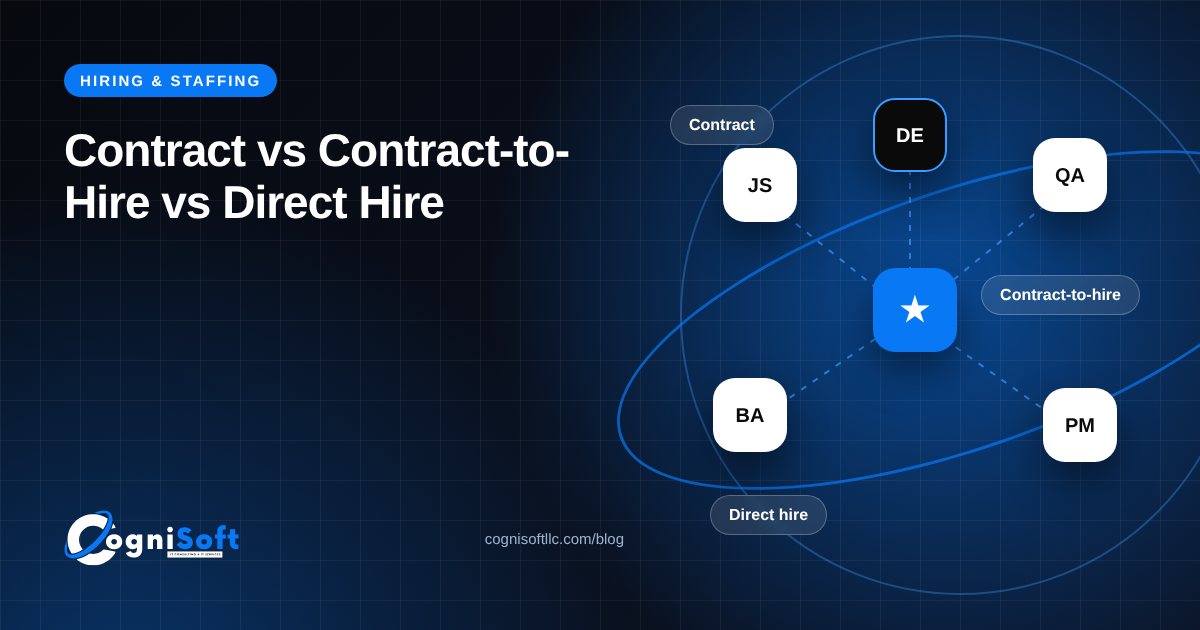
Choose contract staffing for short-term projects or skills you need quickly, contract-to-hire when you want to evaluate a person on the job before making a permanent offer, and direct hire for core long-term roles where retention and culture fit matter most. Many companies mix all three.
Key takeaways
- Contract: fastest to start, flexible, ideal for projects and peaks in demand.
- Contract-to-hire: lowers hiring risk by letting both sides test the fit first.
- Direct hire: best for core, long-term roles and building institutional knowledge.
- The right model depends on duration, budget, urgency and how critical the role is.
Contract staffing
With contract staffing, a professional works on your project for a defined period while the staffing partner handles sourcing and screening. It's the go-to model when you need a specialist quickly — a Salesforce developer for a migration, extra QA engineers before a release, or a data engineer for a six-month pipeline build.
Best for: fixed-length projects, seasonal peaks, niche skills you don't need permanently, and situations where headcount approval is slow.
Contract-to-hire
Contract-to-hire starts as a contract engagement with the intention of converting the person to a full-time employee after an agreed period, often three to six months. Both sides get to evaluate the fit on real work before committing.
Best for: roles where technical skill is easy to test but team fit is harder to predict, and for companies that want to reduce the cost of a mis-hire.
Direct hire
In a direct-hire search, the staffing partner sources, screens and presents candidates, and you hire the selected person onto your payroll from day one. It takes longer than contract staffing but builds a stable core team.
Best for: leadership roles, architects, long-term product engineers and any position where retained knowledge is a competitive advantage.
Side-by-side comparison
| Contract | Contract-to-hire | Direct hire | |
|---|---|---|---|
| Speed to start | Fastest | Fast | Slower |
| Commitment | Project-based | Trial, then permanent | Permanent |
| Hiring risk | Low | Lowest | Higher |
| Best for | Projects & peaks | Uncertain fit | Core roles |
How to decide
Ask four questions: How long will we need this skill? How urgently? How critical is long-term knowledge in this seat? And how confident are we about the profile we need? If the answers are “short, urgent, low, unsure,” start with contract. If they're “long, not urgent, high, confident,” go direct hire. Everything in between is a strong case for contract-to-hire.
CogniSoft supports all three models — plus dedicated teams — so you can change approach as your needs evolve.
Frequently asked questions
What is contract-to-hire in IT staffing?
Contract-to-hire is an arrangement where an IT professional first works on contract for a set period, typically three to six months, and is then offered a permanent position if both the company and the professional agree it is a good fit.
Which staffing model is cheapest?
It depends on duration. Contract staffing has a higher hourly cost but no long-term commitment, which is often cheaper for short projects. Direct hire costs more up front but is usually more economical for roles you will need for years.
Does CogniSoft offer all three models?
Yes — contract, contract-to-hire, direct hire and dedicated teams. Share your requirement at hr@cognisoftllc.com.
Need help with this?
Talk to CogniSoft about IT staffing, career services, web & app development or digital marketing. Email hr@cognisoftllc.com or call +1 (307) 529-0408.
The CogniSoft Team combines IT recruiters, career coaches, developers and digital marketers based in Sheridan, Wyoming. We write practical guides from our day-to-day work helping professionals get hired and businesses grow.